


Innovative Technology for Improved Energy Efficiency and the Use of Renewable Energy Sources
Background
High-temperature heating of buildings and industrial processes is identified as one of the major challenges at both regional and local levels due to the heavy reliance on non-renewable energy sources and the very low share of renewable energy. To improve energy efficiency and increase the use of renewable energy sources for high-temperature heating, innovative technical solutions have been developed.
Description of Invention
In recent decades, significant efforts have been made in the EU and worldwide to ensure cleaner air and reduce greenhouse gas emissions. Numerous agreements and protocols addressing environmental issues have been adopted. Monitoring energy consumption in Europe and increasing the use of renewable energy sources—alongside energy savings and improved energy efficiency—are key measures required to reduce greenhouse gas emissions.
Currently, high-temperature heating in buildings and industry is typically provided by hot water boilers and combined heat and power (CHP) units. CHP systems achieve an overall efficiency of approximately 85% based on the lower heating value of the primary fuel, but are often not economically viable without subsidies.
Due to the high dependence on non-renewable energy sources and the low share of renewables, high-temperature heating remains a major challenge at regional and local levels. To address this, innovative technical solutions have been developed to improve fuel efficiency and increase the use of renewable energy sources.
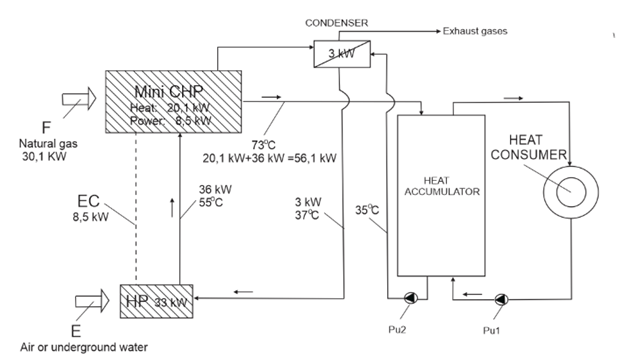
The novelty of the demonstration project lies in the unique integration of a mini combined heat and power unit (27% electrical efficiency), a heat pump (HP), a flue gas condenser of the CHP gas engine, and thermal storage units. The heat user draws heat from the thermal storage tank according to heating demand.
Cold return water from the thermal storage is first directed to a water vapor condenser located in the exhaust gases of the mini CHP gas engine, where it is preheated by a few degrees Celsius. It is then routed to a water-to-water heat pump, where low-temperature renewable heat sources (such as groundwater or geothermal probes) are utilized to heat the return water to approximately 55°C. The water is subsequently directed to the mini CHP unit, where it is further heated to the final temperature (in this case, 73°C), and then returned to the thermal storage tank.
Electricity generated by the mini CHP unit is used to power the heat pump compressor.
Main Advantages
The demonstration project anticipates increasing fuel efficiency (natural gas, diesel, liquefied petroleum gas, etc.) by up to 230% through the use of renewable energy sources via a heat pump for high-temperature building heating. Approximately 80% of the heat is generated from low-temperature renewable energy sources.


