


Affinity ligands of the Fc region of antibodies
Background
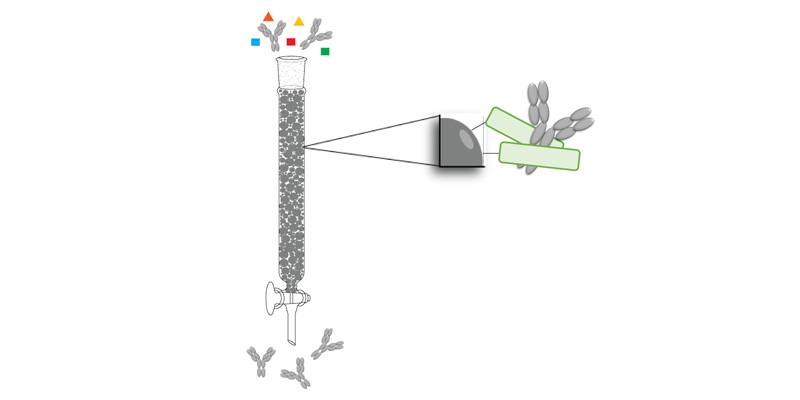
Simple linear peptides selective for the Fc region of antibodies were developed using the principles of molecular evolution. When coupled to chromatographic matrix, synthetic peptides are capable of enriching antibodies from complex feedstocks, reaching purities comparable to conventional staphylococcal protein A-based methods.
Description of invention
In the proof-of-principle experiments the peptides were shown to possess affinity to selectively enrich antibodies from cell growth medium and human serum using peptide-functionalized pull-down beads and a prototype affinity chromatographic column. Another potential application of peptides as biorecognition reagents is in immobilizing capturing antibodies to a biosensor surface. The technology is especially appropriate for research purposes in areas of molecular biology, biophysics, as well as preclinical evaluation and development of therapeutic or diagnostic antibodies.
Main advantages
In contrast to protein A, the peptide ligands are less susceptible to harsh inter-run cleaning-in-place decontamination conditions, since they do not rely on intricate peptide chain folding for binding affinity and can be affordably produced synthetically. This translates to extended affinity column lifetime. Furthermore, the peptides bind all subclasses of immunoglobulin G.