


Extraction of Food Waste for the Production of Bacterial Cellulose
Background
Bacterial cellulose is a highly useful material, for example in the production of medical dressings, as an ingredient in the food industry (thickener, flavor, aroma, color), for food packaging, and as a sustainable textile. However, its broader application is limited by production costs, a significant portion of which arises from cultivating the bacteria that produce cellulose. This technology introduces an extract derived from food waste that replaces expensive conventional bacterial growth media.
Description of Invention
Bacterial cellulose is widely used as a thickener and stabilizer in food products and can also be used to reduce caloric content in dietary items.
It also plays an important role in product packaging, particularly in the food sector, where it can help prevent or reduce the use of plastic packaging. In medicine, one of the most promising applications of bacterial cellulose is in wound treatment, especially for burns, as well as in implants or substitute structures for the cardiovascular system, digestive tract, and urinary system.
Bacterial cellulose is pure, strong, has a high water-holding capacity, and can be easily shaped. Additionally, certain properties of the produced cellulose can be controlled, which is particularly important for applications in medicine, food, cosmetics, paper production, and the textile industry.
However, the production of bacterial cellulose is very expensive, with the main costs associated with synthetic growth media, where the carbon source accounts for approximately 30% of the total cost. The revalorization of food waste in this context represents a highly promising and sustainable approach.
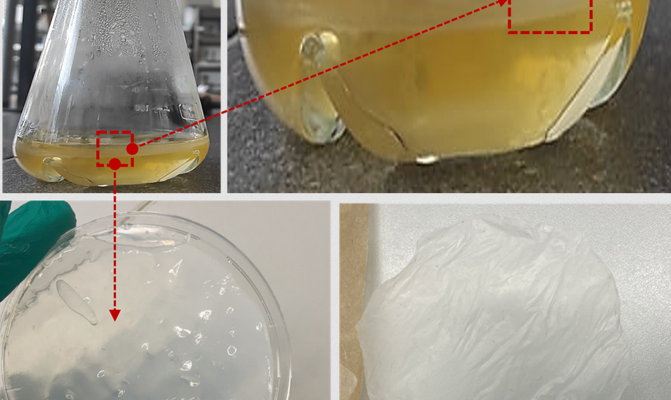
The technology uses a simple and cost-effective process, without the use of enzymes or acids, to convert food waste into a new growth medium. The newly developed extract is sufficient for bacteria to produce a 100% cellulose membrane without the need for additional supplements or complex media.
The resulting cellulose membrane is ultra-pure, exhibits high wet strength, excellent water-holding capacity, biocompatibility, and an ultra-fine nanofibrous morphology, making it highly attractive for applications in medicine, pharmaceuticals, food packaging, textiles, and more.
Main Advantages
Conventional growth media are mixtures of components required for optimal bacterial growth. Because they consist of multiple ingredients, their production can be costly and energy-intensive. This technology provides a more affordable and environmentally friendly solution.
The research team has optimized the extraction process from food waste, meaning that the raw material is readily available and widely accessible on the market. The extract contains all the necessary components—growth factors as well as micro- and macronutrients—for bacterial growth, and has been proven to effectively support bacterial cultures for cellulose production.
Furthermore, the extract can be adapted for use with other bacterial strains or for the production of additional bacterial products with industrial applications across multiple sectors, including medicine, the food industry, the paper industry, the textile industry, and flexible electronics.