


Real-Time 3D Monitoring of Smart Textiles
Background
Smart textiles have significant potential in sports science and medicine, as well as in the entertainment industry (e.g., motion capture technology). This technology further enhances that potential by creating a 3D digital twin of smart textiles, enabling the measurement of deformation and movement while they are being worn.
Description of Invention
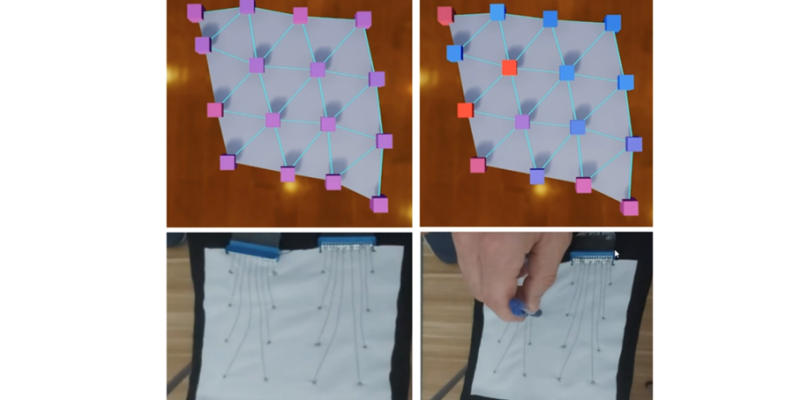
The technology enables real-time monitoring of surface deformations based on measurements of changes in the electromagnetic properties of conductive fibers in elastic textiles during stretching and contraction. The reconstructed 3D geometry allows simulation of textile behavior in a virtual environment and precise analysis of causal forces, opening the door to numerous new applications in entertainment, medicine, and sports.
The developed system enables accurate reconstruction of the 3D surface after textile deformation by measuring electromagnetic properties such as electric current, conductivity, or resistance. These measurements are then converted into distances between measurement points and used to iteratively update the positions of vertices in a schematic 3D model within a virtual environment, achieving full 3D reconstruction.
Because elastic textiles adapt to objects and forces acting upon them, the system can be used for motion tracking, muscle monitoring, tracking forces between objects, and monitoring the movement of objects attached to the textile.
Main Advantages
The technology leverages the inherent nature of smart textiles as an interconnected network of electrical or conductive fibers. Coordinates can be derived from the intersections of these fibers, providing physical measurement points in space within a 3D computational model. When force is applied to the textile—for example, when it stretches while being worn over a part of the body—the distances between coordinates change. These changes can be measured and used to update the 3D model in real time.
The technology offers an excellent alternative to tensiomyography, a technique used to measure muscle contraction commonly applied in sports medicine and rehabilitation. Conventional tensiomyography devices are bulky and can only perform single-point measurements per muscle. In contrast, smart textiles provide a large number of measurement points—essentially every fiber intersection—and can be worn, allowing for natural movement (as opposed to lying still during tensiomyographic measurements).
Similarly, in entertainment applications, motion capture technology relies on point markers and how they reflect light. Smart textiles, with their vastly greater number of data points, provide significantly higher resolution.
Finally, the software used to create 3D digital twins can be applied to any type of smart textile, suggesting that many additional applications may become possible in the future.


